


Plans, Paperwork & Five Dollars: September 21
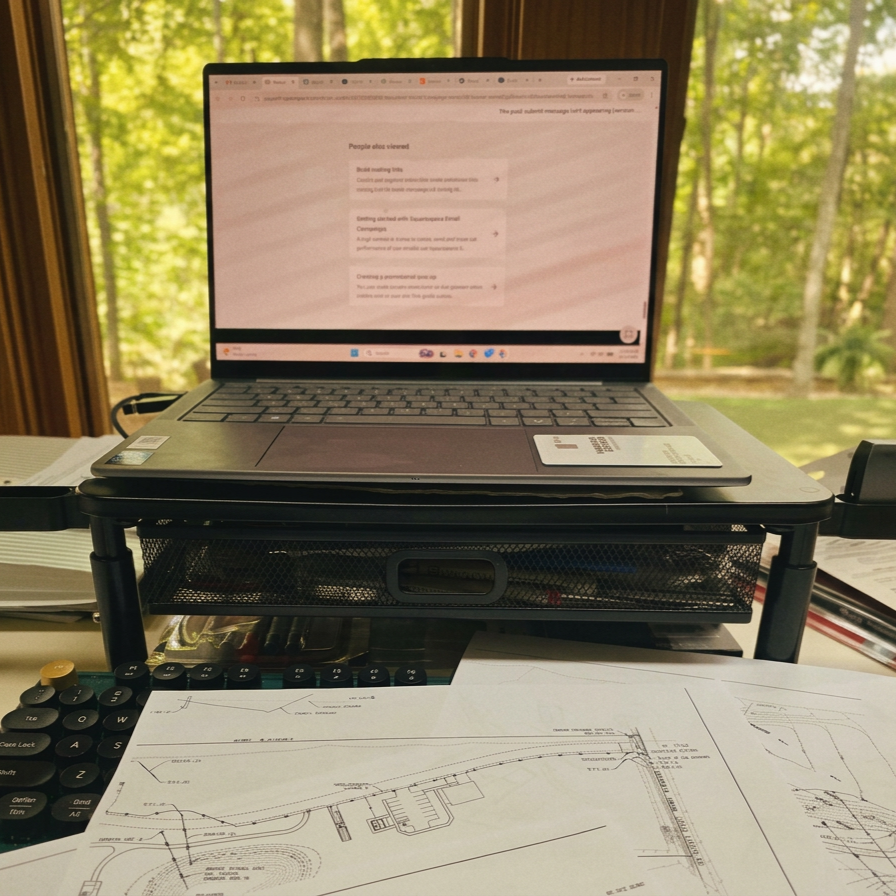
The final engineering plans are in. (Thank you, Chad at Fehr Graham!)
We are nearing the stage of submitting a rather impressive collection of plans, documents, and applications—which means we are one step closer to seeing some actual activity in the fifteen-acre field that is to become The Clearing.
This part of the work is exceedingly important, but it does not always feel like progress. Opening another PDF cannot compete with the sight of an tractor moving dirt or a construction crew putting up walls. Still, every page reviewed, box checked, and application submitted moves us closer to that day.
We also heard from Sweaty Yeti this week. The sauna plans have been finalized, and the design is officially ADA accessible. That is one more plan ready to be added to the stack headed to our county zoning folks - and one more piece of The Clearing beginning to feel real.
In the meantime, we worked around the rain this weekend to visit two local events: Urbana’s Market at the Square and the Prairie Artist Market at Prairie Fruits Farm & Creamery.
Both were reminders of how lucky we are to have access to so many local food producers, artists, and makers. I love attending events like these - not only to shop, but also to look for things we might eventually feature at The Clearing.
Somewhere between the market stalls, I found myself thinking about five dollars.
These days, five dollars barely makes a grocery receipt flinch. But the U.S. Census Bureau estimates that Champaign County has 85,472 households. How many households does your county have?
If every one of those households redirected just five dollars a week from its existing food budget toward something grown or produced locally, that would amount to more than $22.2 million in local purchasing each year for our county.
No, this is not a formal economic-impact study. It is simply a thought experiment about our collective purchasing power.
Even if only one in ten households participated, we would still be talking about roughly $2.2 million a year.
That is a lot of bread, cheese, coffee, honey, produce, pottery, soap, and whatever else someone nearby is growing, baking, roasting, making, or dreaming up.
At The Clearing, we believe regenerative hospitality should extend beyond the boundaries of our property. Restoring prairie and creating habitat are part of that work. So is finding meaningful ways to support the farmers, bakers, roasters, growers, artists, and makers who help make this region worth visiting.
We are imagining locally produced foods in our Prairie Breakfast Baskets, thoughtfully selected goods in the Outpost, and seasonal experiences that introduce guests to the people growing and making things here.
The Clearing will not be single-handedly redirecting $22 million into the local economy. Our budget would like me to make that very clear.
What we can do is be intentional about where our dollars go. We can choose local products when it makes sense, build relationships with the people behind them, and help our guests discover more of what is being grown and made around us.
At a time when we do not always know where commercially produced food comes from - or exactly what it contains - those purchasing decisions feel increasingly important. Five dollars may not seem like much. Neither does one completed form or another approved plan.
But small choices accumulate.
For now, progress looks like engineering plans, permit applications, and five-dollar decisions. Before long, I hope it looks like dirt moving.
Pins, Plans and a Saturday Drive: September 14
It has been another week of small but meaningful progress at The Clearing.
My friend Steve and his crew from Burnett Tree Service came out to trim several dead branches from the beautiful oak tree that sits near the corner of the property. They could finally get their equipment to it because Clark mowed the field last week. One job made room for the next, which seems to be how most of this project works.
The property pins are now marked, and we are finalizing the topography and drainage plans. Well, mostly finalizing them.
We still need to move a berm that was placed directly in the sightline between a couple of the cabins and the pond and prairie. A berm can be useful. A berm blocking the view we are designing the cabins around is considerably less useful. So that will need to shift.
We are also waiting for approval to move forward with the well, which will be handled by Kickapoo Drilling in Downs, Illinois.
All in all, we are hoping October brings the breakthrough we need to finally break ground. We have an electrician, an excavation crew, and a construction crew ready to go. Everyone is standing at the starting line. We just need permission to run.
This past weekend, I took a break from plans, pins, and approvals and drove down to Arcola and Arthur.
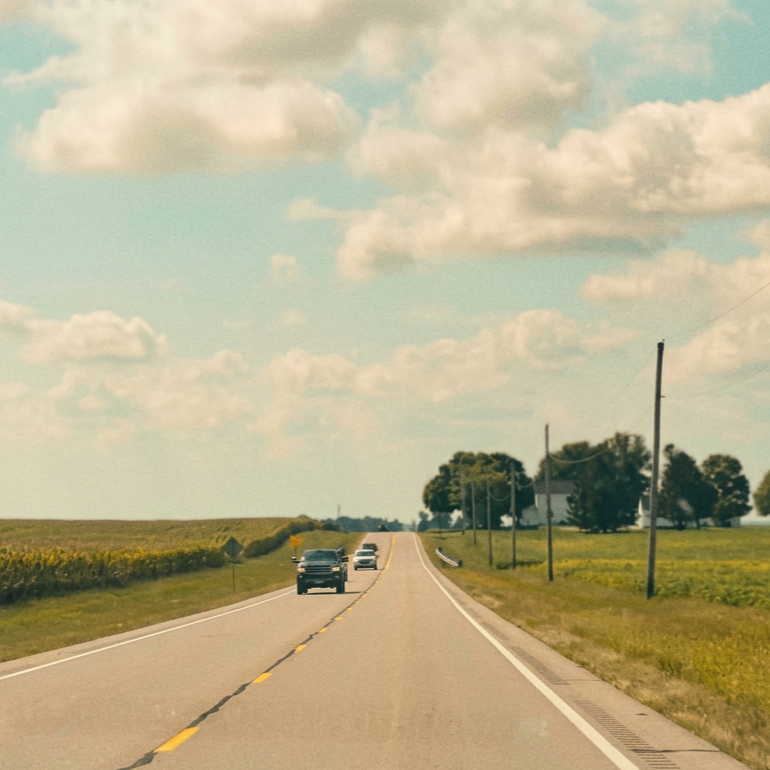
I love taking the backroads from The Clearing. It is about a 45-minute drive to Arthur if you take the leisurely route through the countryside. The corn is beginning to dry now, and the fields are slowly changing color. Fall is not quite here, but it is certainly on its way.
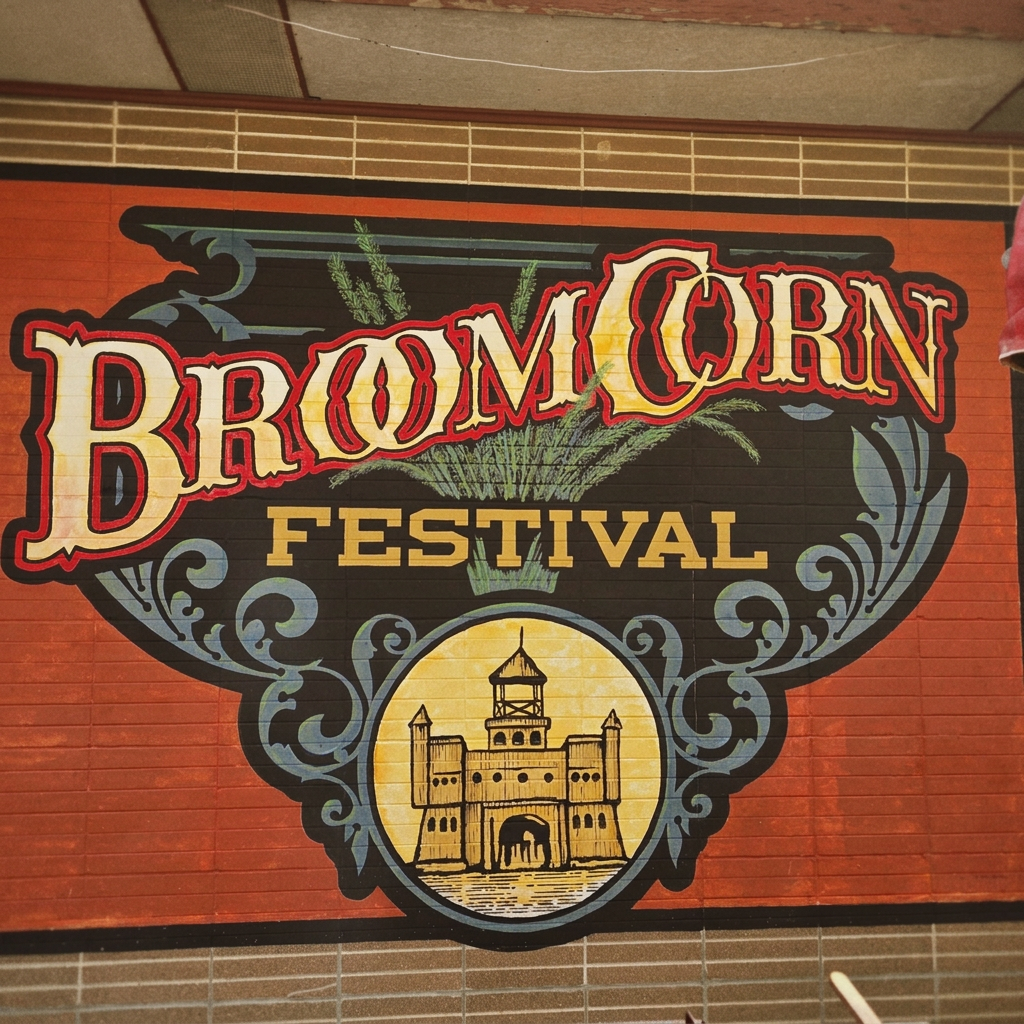
This weekend was Arcola’s 55th annual Broom Corn Festival. I stopped and browsed the festival, but what I enjoyed most were the downtown businesses that are there all year, long after the vendors and parade have gone home.
There is Yoder’s Homestead Shop, Wildflower Soul Boutique, Vint-ish, and Broomtown Café, a peaceful little café inside an old bank building with good coffee, breakfast sandwiches, pastries, avocado toast, and cappuccinos.
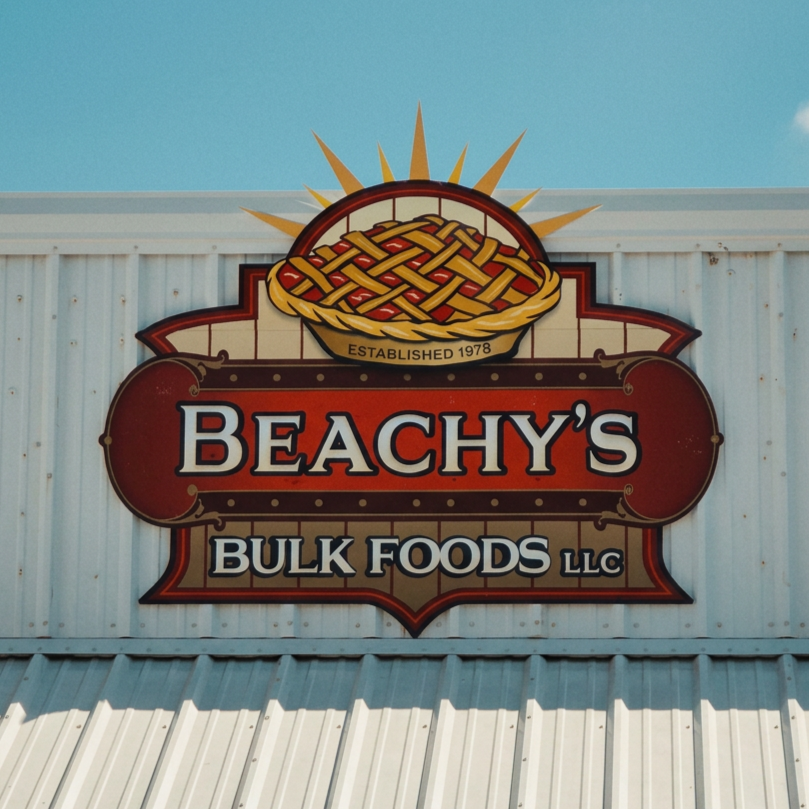
After leaving Arcola, I drove just down the road to Arthur, where I always enjoy stocking up on locally grown and produced food. I stopped at places like Beachy’s Bulk Foods, Shady Crest Farm Market, Family Health Foods, Dutch Valley Meats, and Das Schlacht Haus (which was closed on Saturday, unfortunately).
On this particular Saturday, I did not even venture into the many antique and gift shops scattered throughout the area. I also skipped the Illinois Amish Heritage Center, Aikman Wildlife Adventure, and The Great Pumpkin Patch. There is easily more here than anyone can fit into a single day.
We usually finish an Arthur trip with dinner at Yoder’s Kitchen. I was by myself this time, so I ordered chicken dinners to go, tucked them into my insulated tote, and drove them home.
They traveled perfectly. The chicken was to die for, as usual, and everyone in the house was satisfied. The pantry and freezer received a little restocking, too.
I came home with bags of food, a few chicken dinners, and the same thought I keep having as The Clearing takes shape: we are incredibly lucky to live so close to an area like this.
The Clearing will be a place to slow down and stay awhile, but I also hope it becomes a starting point for discovering the farms, shops, food, backroads, and people that make this part of Illinois so special.
For now, we will keep moving forward one oak branch, one survey pin, one revised berm, and one approval at a time.
Come on, October!

Technology, Tractors & Good Neighbors: September 10
It has been quite a week in the news where technology is concerned.
First, an AI safety researcher said he believes there is a greater than 10% chance that advanced AI could wipe out humanity within the next decade. Geoffrey Hinton (one of the so-called godfathers of AI) said that estimate was not unreasonable. So, that was encouraging. (The Guardian)
Then I watched a short documentary by Sanina Million (an influencer, which is another job title that did not exist when I was in high school) about how little control we retain over the things we supposedly own.
Her piece focused on John Deere and the fight over whether farmers should be able to repair their own tractors. It cited an estimate that repair restrictions cost American farmers $4.2 billion each year. The exact figure is an estimate, but the larger right-to-repair issue is very real. The Federal Trade Commission sued Deere over its repair practices in 2025, and a settlement announced this summer would require the company to make diagnostic and repair tools available to owners and independent mechanics. (Reuters, Associated Press)
The same basic strategy shows up in our phones, cars, appliances, and digital purchases. We pay for them, bring them home, and call them ours - until we want to repair, alter, or sometimes even continue using them.
And yes, I recognize the contradiction here. I use AI to create many of the illustrations for these Field Notes.
Why? Because I am not an artist or a designer, but I usually have a fairly clear idea of how I want something to look. AI helps me translate that idea into an image quickly, efficiently, and at little to no cost. I appreciate what it makes possible. I also dislike the environmental burden of enormous data centers and feel uneasy about plenty of what I read concerning where this technology may be headed.
I suppose that puts me where many people are right now: standing somewhere between amazement and concern, trying to decide what progress is worth and what it may be costing us.
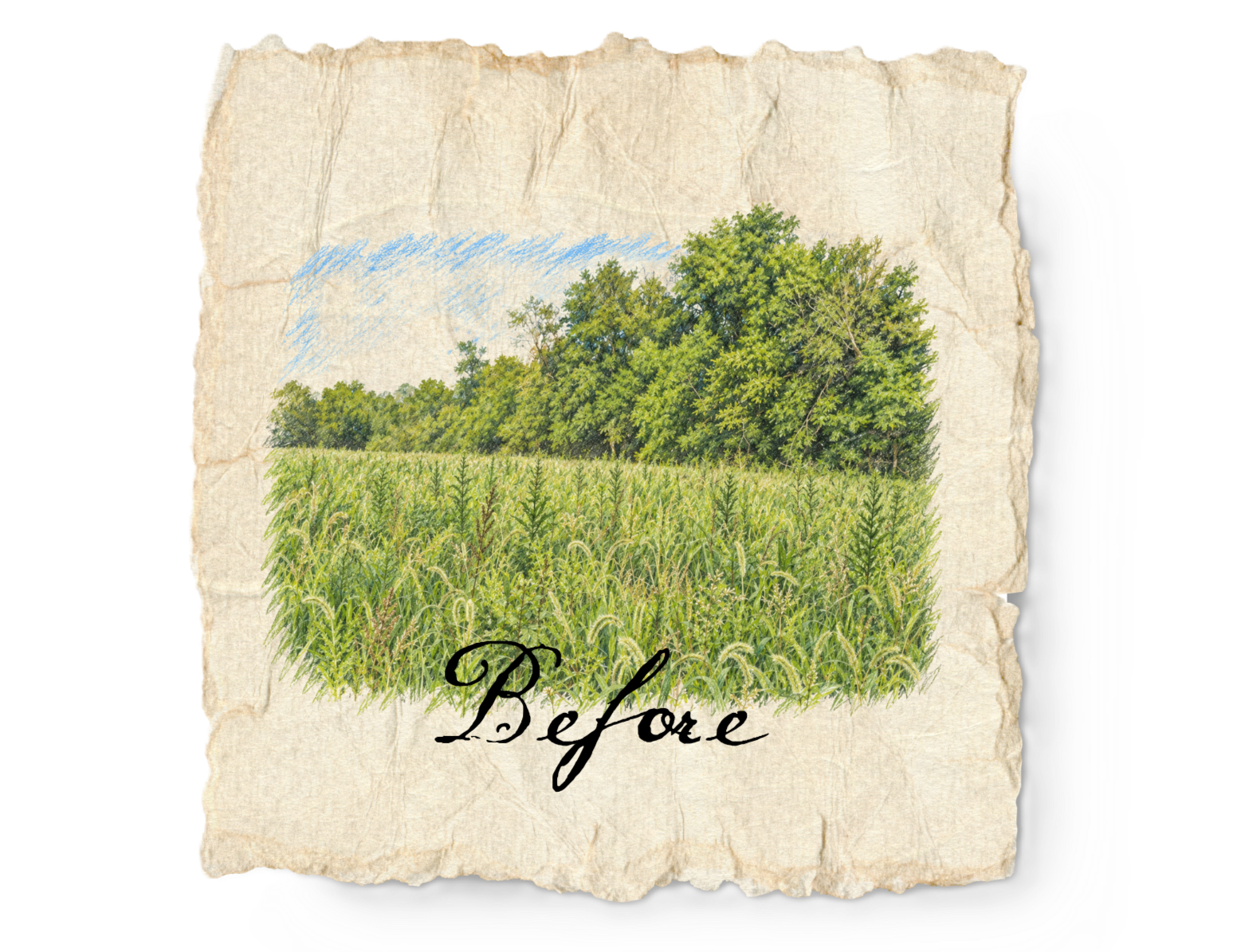
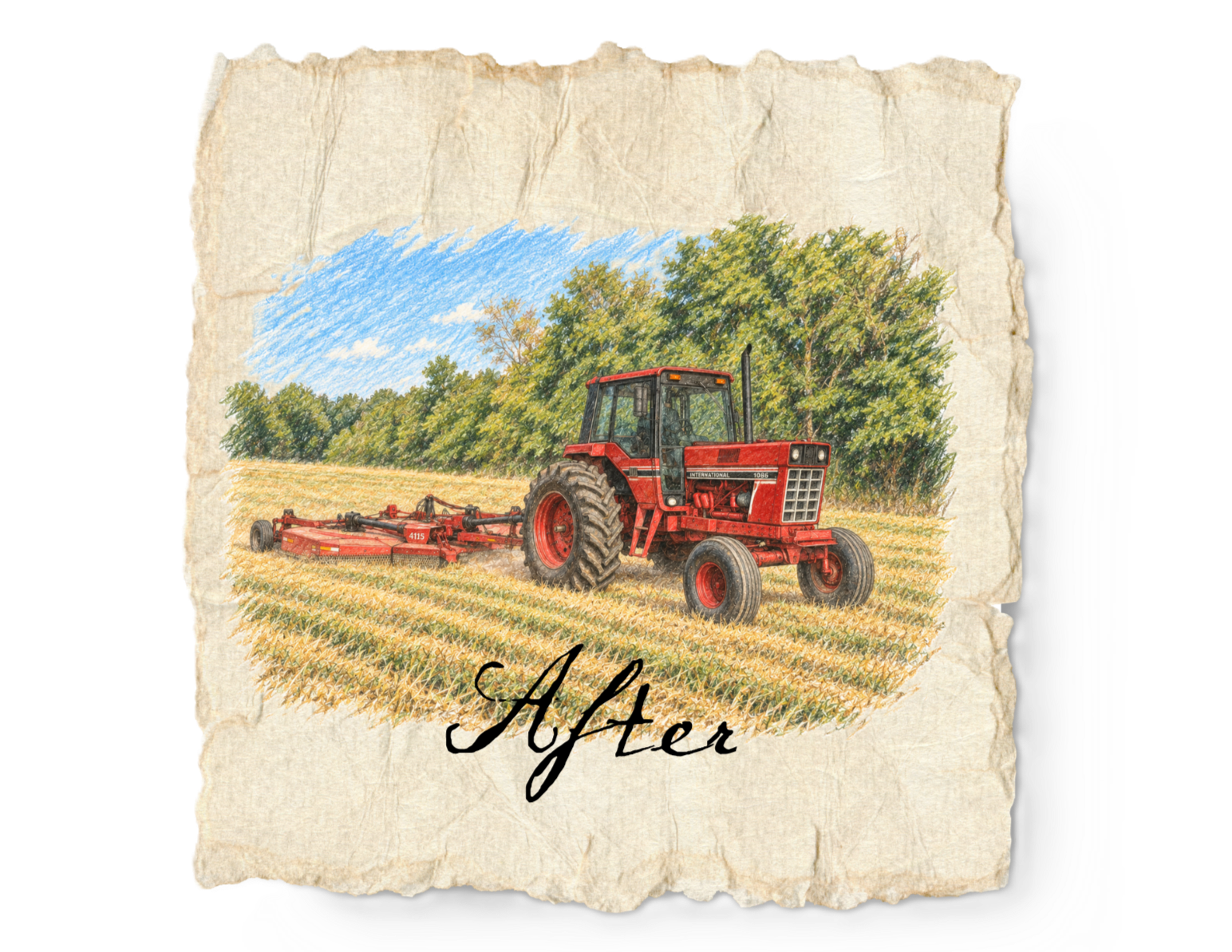
All of that was rolling around in my head yesterday when a local farmer named Clark generously drove down to mow the fifteen acres where The Clearing is taking shape. This was no small favor. The weeds were almost as tall as I am.
I did not find Clark through an app, an algorithm, or an online service. In fact, I had been struggling to find someone who could help.
Then I talked to Allen from Hershberger Construction. You may remember him from the story about our post-frame Grounds House. Allen builds for quite a few farmers, knows a lot of people, and is simply a nice and likable guy. If I were still living on the farm where I grew up, I would have called him a good neighbor.
Allen put out a few feelers among his former clients, and lo and behold, he found Clark. Thank God.
When Clark called to say he had finished, I drove out to deliver his check and meet him in person. His tractor was not new or fancy. It was an old red IH - a workhorse that has clearly seen a few fields in her day.
I loved it.
Clark did a beautiful job. More importantly, I now know someone who may be able to help when we need the land disced later this year or when it is time to plant pollinator seed. There was no platform or subscription involved. Allen knew Clark. Clark had a tractor. I needed a field mowed. Sometimes the old systems still work remarkably well.
Maybe the answer is not choosing between technology and a simpler way of doing things. Maybe it is remembering what each one is actually good for.
AI can help me create an illustration I could never draw myself. It cannot drive down the road in an old IH and mow fifteen acres. A phone can connect us with almost anyone, but it cannot replace a neighbor willing to make a call on our behalf.
There is comfort in those older rhythms: good neighbors, pancakes made with freshly milled flour from Janie’s Mill, the crunch of an apple from a local orchard, and work done by someone whose name you know. That slower and more familiar pace can be a welcome reprieve from the daily grind, the technology, and - most certainly - the news.
That is what we hope The Clearing will offer.
Step inside. Put your phone in the box provided and put it away for a while. Pick up a book or pull out a game. Sink into the hot tub. Start a fire. Listen to the crickets. Roast a marshmallow… or six. Make a cup of tea or pour a cocktail. Take a hot shower. Go to bed early.
There is nothing on the schedule.
So do nothing, and enjoy an older, slower rhythm.

More Than Flyover Country: September 5, 2026
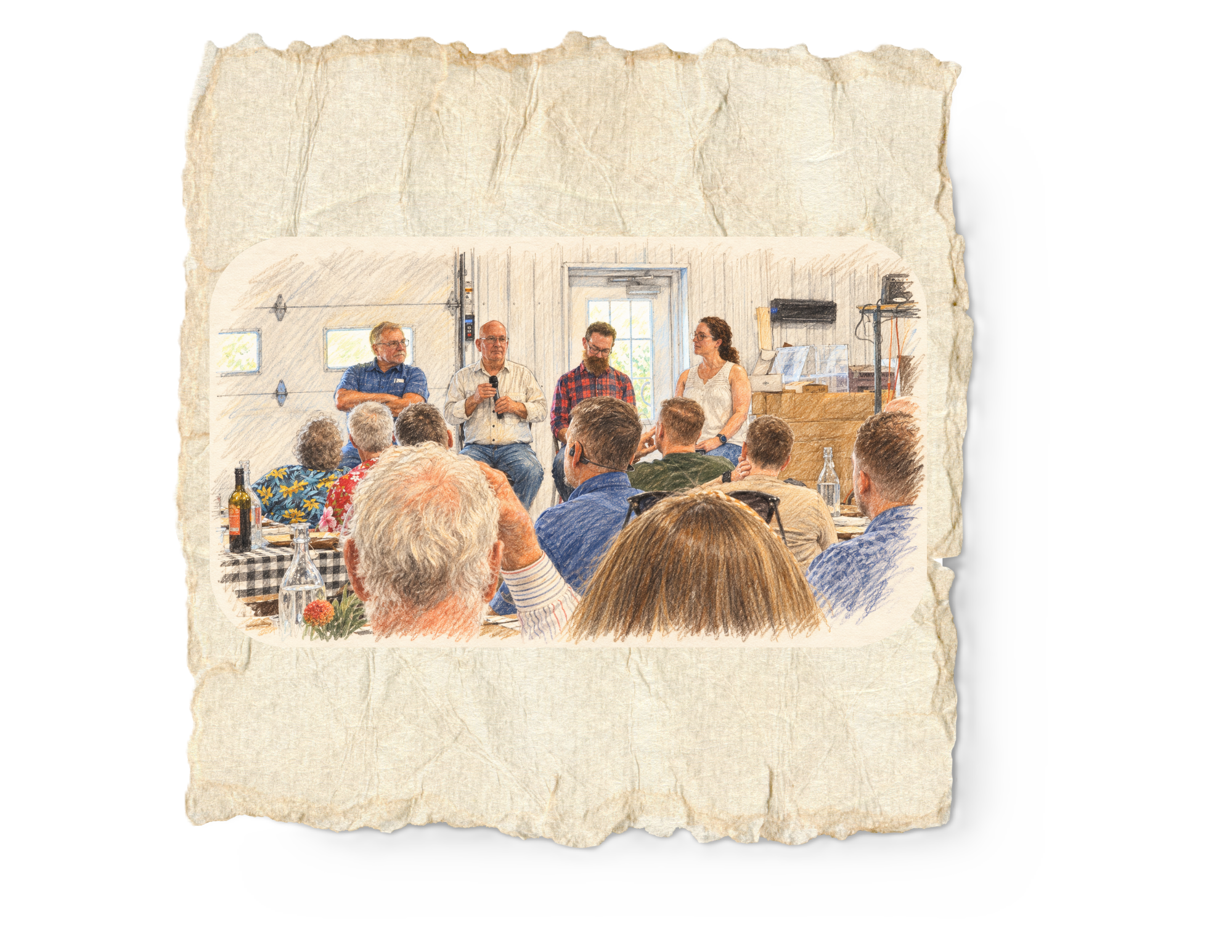
Tonight I had the opportunity to attend a special gathering at Prairie Fruits Farm & Creamery, and I left feeling immensely inspired.
Central Illinois is easy to reduce to acres of corn and soybeans viewed through a car window somewhere between one interstate exit and the next. But tucked among those fields are deeply devoted farmers, millers, makers, and families working to preserve a very different kind of agricultural tradition.
The evening centered on slow grains and the effort to bring more locally grown grain back into our regional food system. Illinois produces an enormous amount of grain, but much of it enters the global commodity market—headed for livestock feed, fuel, export, or industrial processing rather than our own tables.
We heard from Harold Wilken of Janie’s Mill, Marty Travis of Spence Farm, and Jeff Hake & Katie Funk of Funk’s Grove Heritage Fruits & Grains. They talked about grain grown for flavor and nourishment, milled close to home, and connected to the farmers, bakers, brewers, chefs, and neighbors who give it value.
It is one thing to buy local flour, cheese, or produce from the shelf of an organic grocery store. It is another thing entirely to sit with the people who made it—to hear the why behind their work somewhere between the storytelling and the belly laughs.
The gathering was connected to Slow Food USA, an organization built around the belief that food should be good, clean, and fair. One of its projects, the Ark of Taste, catalogs heritage foods, crops, and traditions at risk of disappearing. The idea is beautifully practical: we preserve these foods by continuing to grow them, cook them, serve them, and ask for them.
Sitting there, I kept thinking about inheritance. These seeds, skills, recipes, and ways of caring for the land were handed down to us by people who came before. Now they are ours to nourish—and eventually pass along to those who come after.
I also kept thinking about The Clearing and what I hope guests will discover when they come here. Not a polished or packaged version of Central Illinois, but a doorway into the real one: the farms, the people, the stories, and the food that make this place worth slowing down for.
There is so much more here than most people ever see from the interstate. Sometimes all it takes is pulling off the road, sitting down at the table, and listening for a while.
A Home Base for the Work: September 2nd, 2026
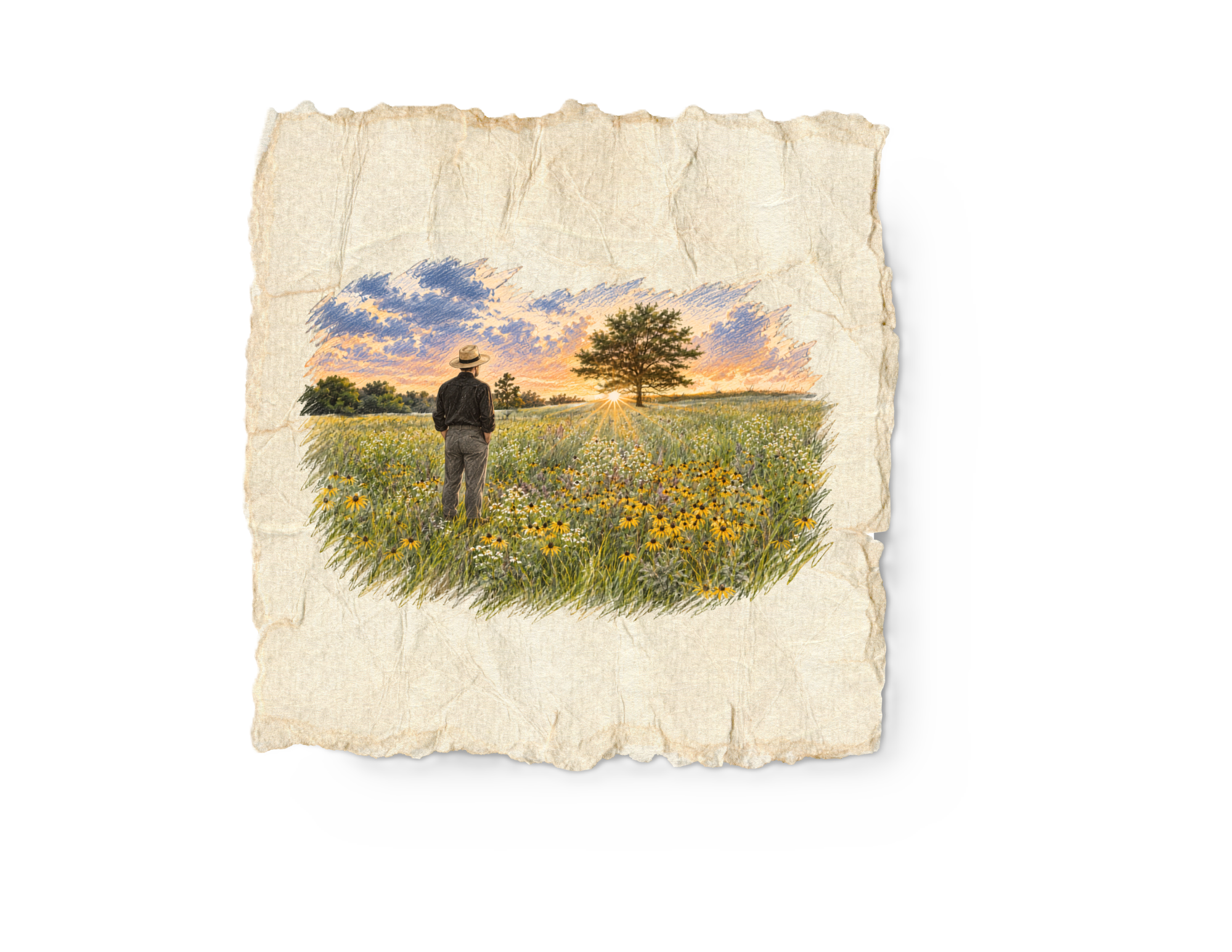
I had the pleasure of meeting with Allen from Hershberger Construction today. He is one of those people who makes a complicated project feel a little more manageable. He follows up, answers questions, and brings genuine enthusiasm to his work.
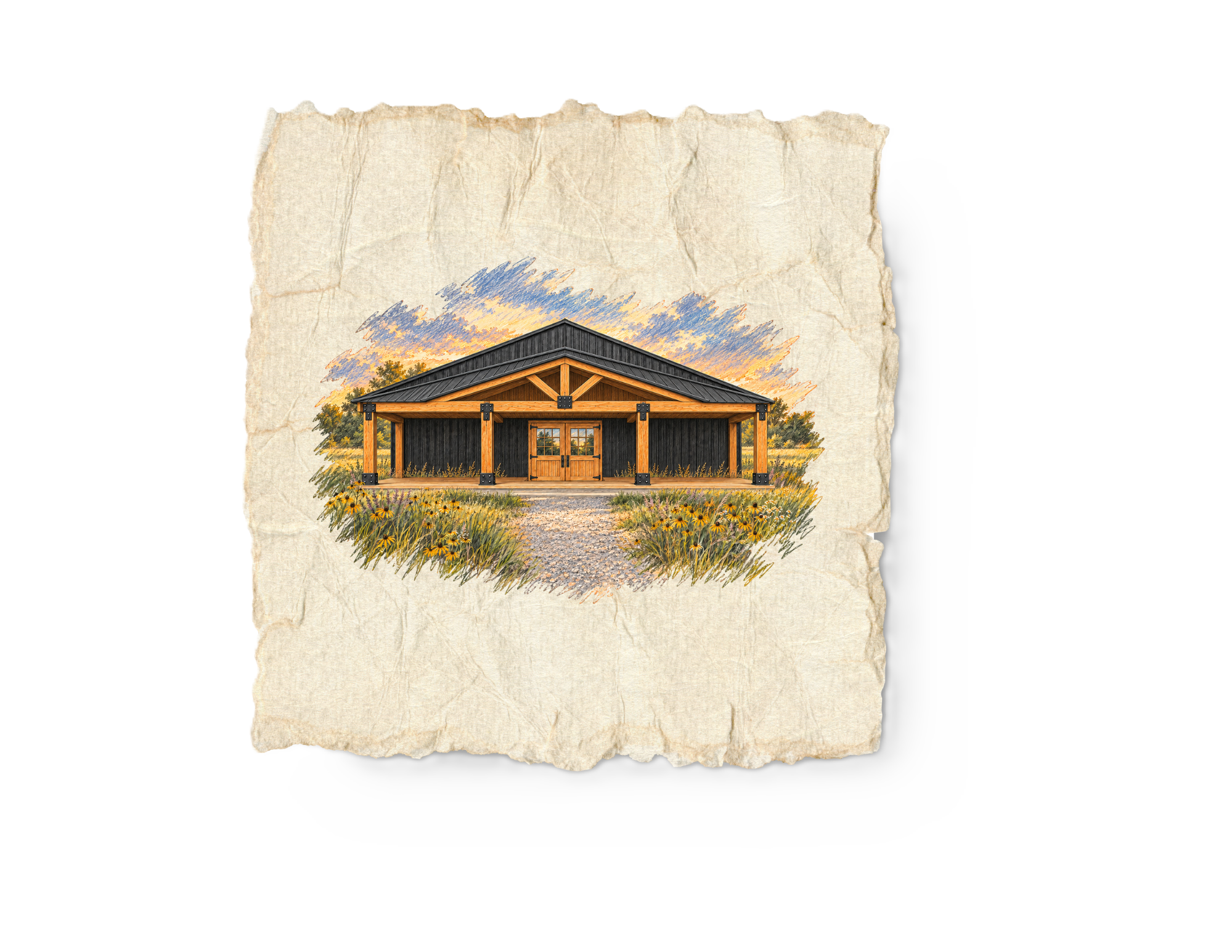
Hershberger Construction will be designing and building our black steel pole barn—what we are calling the Grounds House. It will serve several purposes: storage, office space, an equipment area, a place to stage supplies, and probably a few things we have not thought of yet. It may not be the most romantic part of The Clearing, but it will be the central hub for managing and caring for the property.
We are excited to begin this portion of the project just as soon as the necessary paperwork and approvals are complete through Champaign County Zoning. Right now, we are waiting on final drainage plans, fire-safety plans, and several other boxes that still need to be checked. Thankfully, our friends and engineers at Fehr Graham are helping us work through all of it.
There are so many steps in a project like this. Some days, progress looks like buildings and prairie. Other days, it looks like plans, paperwork, and approvals.
Either way, we will keep moving through it—one step and one checked box at a time.

A Sweaty Yeti on the Prairie: August 20th, 2026
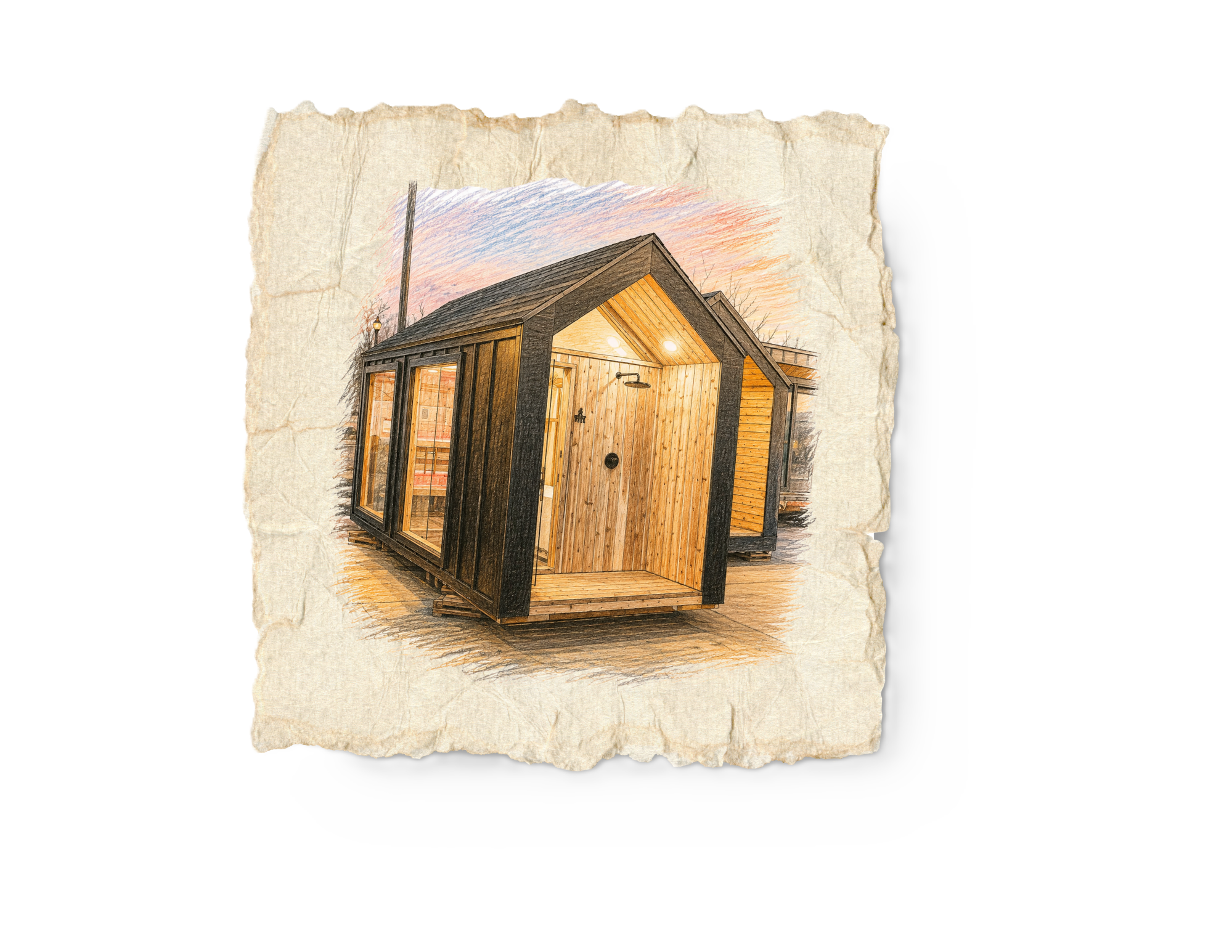
I’ve been working with Corey at Sweaty Yeti on the sauna for The Clearing. Yes, the name itself practically makes the sale. The logo helps, too.
Sweaty Yeti saunas are made by Irontown Modular in Utah, with several different layouts & a long menu of optional additions. They are clean and modern, but still warm and inviting—the kind of place you actually want to settle into.
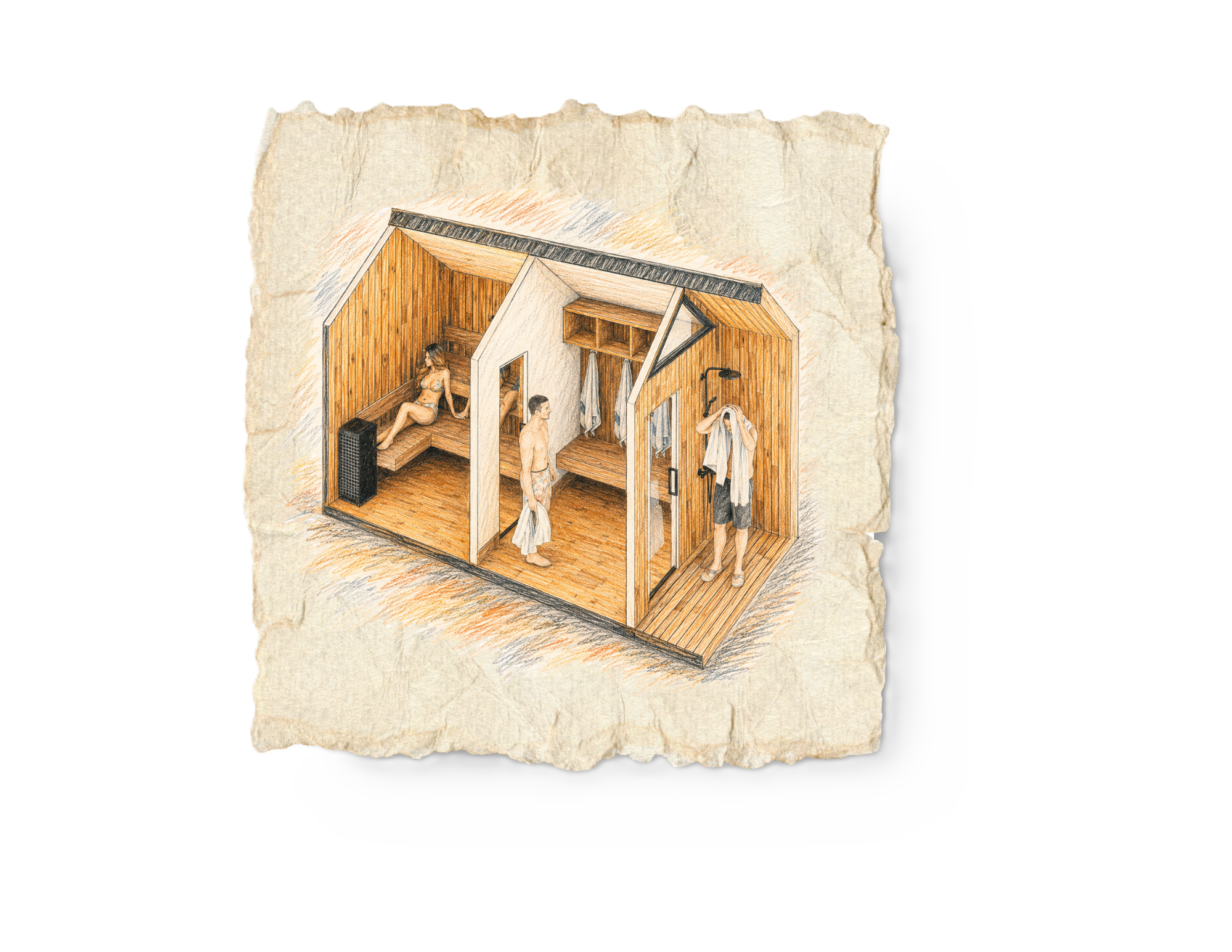
One decision we made early was to include a fully enclosed changing area. It might be tempting to leave everything open, but then I remember that we live in Illinois. As they say, if you don’t like the weather, just wait five minutes.
The changing room will give guests a warm, protected place to change, hang a robe, and ease into the experience. Whatever the weather decides to do outside, the sauna will be hot and ready.
Sauna bathing supports cardiovascular health, soothes sore muscles, reduces stress, and helps some people sleep better. The heat creates a natural opportunity for the body—and mind—to slow down. The research is still evolving, but the restorative benefits are promising.
Mostly, I keep picturing someone walking over after a long day or a quiet walk through the prairie, hanging up a robe, stepping into the heat, and staying still for a while.
The sauna is starting to feel like more than just another amenity. It feels like part of the rhythm we are trying to create here: warm up, slow down, breathe, and stay awhile.

Cabin Plans Begin to Take Shape: August 4th, 2026
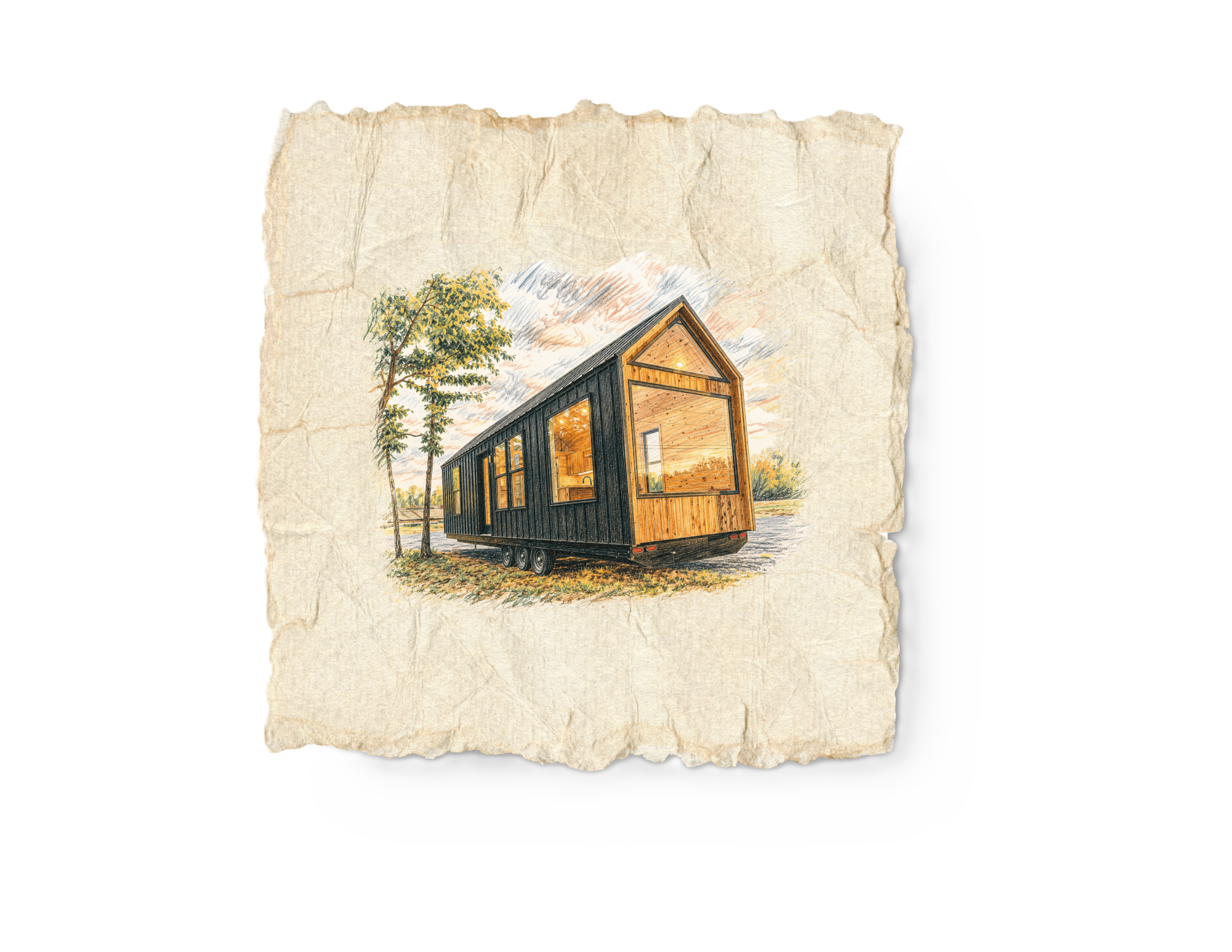
Had a really productive Zoom call today with Jason from Nordic & Spruce. We are beginning the process of designing the cabin layouts for The Clearing, working through each detail with the comfort of our guests in mind.
We talked about everything from window placement and natural light to the views from each room, the flow of the shared spaces, the beds, and the bathrooms. These may seem like small decisions, but together they will determine how each cabin feels—and how easily our guests can settle in once they arrive.
There is still plenty to work through, but it was exciting to begin seeing the cabins take shape. Today felt like a real step forward.